Immerse yourself in centuries-old Himalayan folklore, mystical masked dramas, martial sword dances, sacred seasonal harvests, and the timeless folk arts of Kumaon and Garhwal.
While united under the sacred canopy of the Himalayas, Uttarakhand's two distinct cultural realms boast their own unique dialects, folk dances, musical instruments, and traditional attire.
Nourished by the Katyuri and Chand dynasties, Kumaoni culture thrives on artistic refinement, geometric Aipan floor paintings, the energetic Chholiya martial dance, and melodious Jhora singing celebrating spring romances and mountain life.
Cradled in the valleys of the holy Alaknanda and Bhagirathi, Garhwali heritage is rooted in the Mahabharata epic, sacred Pandav Nritya performances, grand village Doli processions, and the rhythmic beat of ancient Dhol-Damau percussionists.
From the vibrant spring flower blessings of Phool Dei to the 280-kilometer alpine trek of the Nanda Devi Raj Jat, celebrate life in Devbhumi.
March (Chaitra)
Celebrated on the first day of the Hindu month of Chaitra to welcome spring. Young children, known as Phoolyari, gather wild yellow mustard and crimson rhododendron blooms and shower them upon doorsteps of homes singing blessings for health and harvest.
July (Shravan)
Marking the onset of the monsoon and the agricultural planting season, Harela honors Lord Shiva and Goddess Parvati. Nine days prior, families plant seeds of seven grains in small earthen bowls, harvesting the sacred yellow-green shoots on festival day to tuck behind ears as blessings.
August – September
Dedicated to Uttarakhand's patron deity, Nanda Devi (Goddess of Bliss). The annual fairs in Almora and Nainital draw lakhs of devotees with sacred brass idol processions, banana-stem deity carvings, and folk music. Every 12 years, the royal 280-km Himalayan Raj Jat trek is undertaken to Homkund lake.
Raksha Bandhan (August)
Held on the day of Raksha Bandhan at the sacred courtyard of Maa Varahi Temple. Four historic clans (Kham) engage in a spirited mock battle pelting stones and fruits while holding heavy wooden shields (Chhatwa), continuing an ancient tradition of appeasing the Goddess with symbolic blood sacrifice.
May – June (Jyeshtha)
Commemorates the auspicious day the celestial River Ganga descended upon earth through the penance of King Bhagirath. Devotees take 10 dips in the river to cleanse ten specific lifetime sins, offering watermelons, betel leaves, and lighting thousands of floating earthen diyas during twilight aarti.
Late April (Baisakhi)
Inscribed on UNESCO's Representative List of the Intangible Cultural Heritage of Humanity. A multi-day festival of ritual theatre where villagers don handcrafted wooden masks depicting Hindu deities, dancing to epic verses of the Ramayana in honor of Bhumiyal Devta.
The music of Uttarakhand reverberates with the thunderous beat of the Dhol-Damau, the melodious drone of the flute, and the echoing martial horns across terraced mountain slopes.
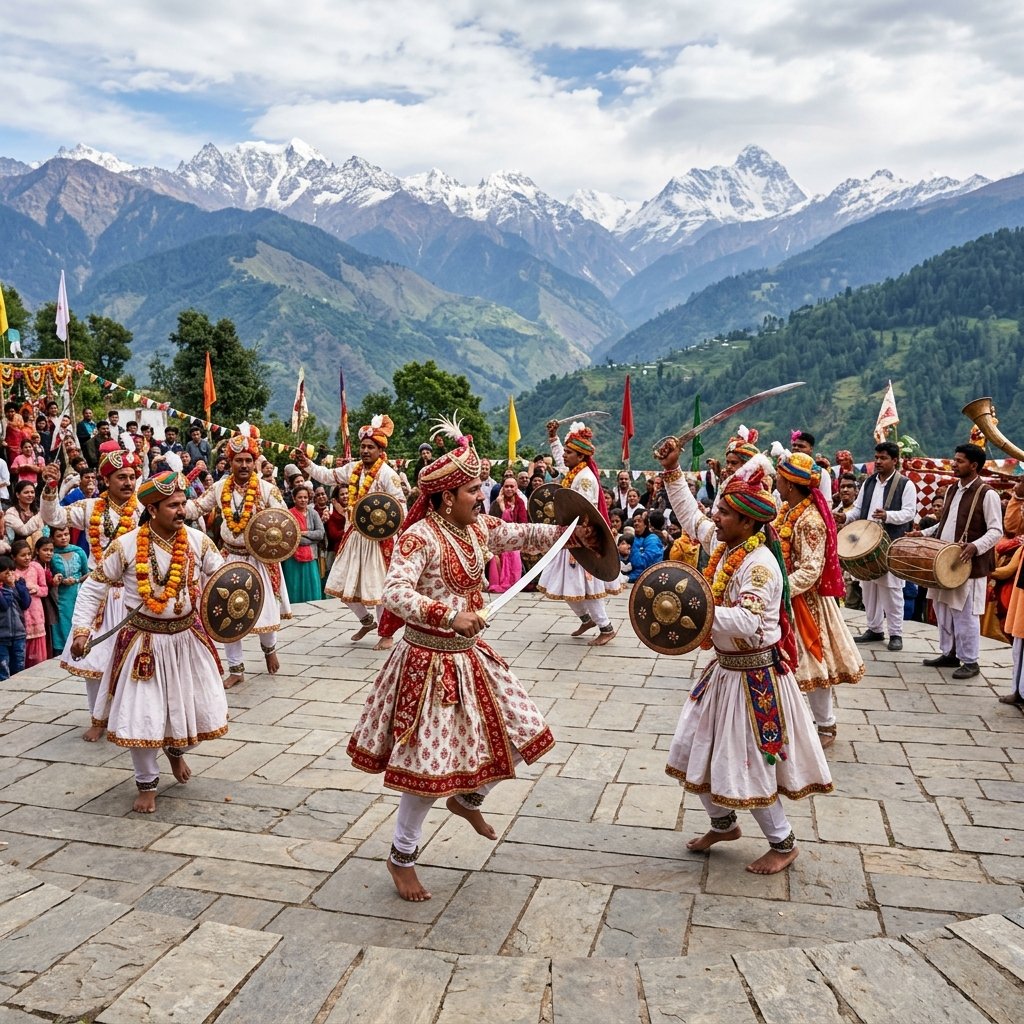
An ancient martial sword dance dating back over a thousand years to the Khasia Rajput warriors. Dancers in flamboyant white and red robes perform acrobatic sword fights to ward off evil spirits during weddings and festivals.
Joyous community circle dances where men and women lock arms and move in synchrony to lyrical mountain couplets, singing about seasons, unrequited romance, and village folklore during spring melas.
A spiritual ritual theatre lasting several nights during the winter months. Villagers become spiritually possessed by the spirits of the five Pandava brothers, wielding traditional weapons to complex Dhol beats.
The spirited folk dance of the tribal Jaunsar-Bawar region near Chakrata. Performed during Bisu (Baisakhi), young boys and girls dress in bright hand-embroidered ghaghras, dancing in sweeping concentric arcs.
Centuries of living in deep harmony with nature have inspired the artisans of Devbhumi to create exquisite ritual art, hand-spun woolens, and master timber carvings.
The signature folk painting of Kumaon. Women coat thresholds, courtyards, and prayer altars with red ochre clay (Geru), sketching intricate geometric patterns, conches, lotus feet of Goddess Lakshmi, and swastikas using white rice-paste (Biswar).
Ancient Pahari timber craft gracing the doors, balconies, and facade pillars of traditional homes and temples. Sculptors carve intricate floral scrolls, deities, and geometric friezes into Himalayan deodar and pine wood.
The sacred saffron-yellow Pichora cloth with red circular paisleys is donned by Kumaoni women during all auspicious ceremonies, complemented by the magnificent oversized gold Nathuli nose-ring and Guloband choker necklace.
Plan your travels to coincide with these spectacular cultural gatherings throughout the year.
| Month | Festival / Mela | Region / District | Cultural Significance |
|---|---|---|---|
| January | Uttarayani Mela | Bageshwar (Saryu Sangam) | Historic trade fair & holy bath on Makar Sankranti |
| March | Phool Dei | Statewide (Kumaon & Garhwal) | Spring festival where children shower flowers on doorsteps |
| April | Bisu / Baisakhi Fair | Uttarkashi, Chakrata, Dehradun | Harvest celebration, archery contests, and Barada Nati dance |
| Late April | Ramman Festival | Chamoli (Saloor Dungra) | UNESCO Intangible Cultural Heritage masked ritual drama |
| May – June | Ganga Dussehra | Haridwar, Rishikesh, Gangotri | Ten-day celebration of Goddess Ganga's descent to Earth |
| July | Harela Festival | Kumaon & Garhwal Valleys | Monsoon greenery festival celebrating agriculture & Shiva-Parvati |
| August | Bagwal Fair | Devidhura (Champawat) | Historic mock stone-pelting battle at Maa Varahi Temple |
| Aug – Sept | Nanda Devi Fair | Almora, Nainital, Chamoli | Grand fair dedicated to Uttarakhand's patron Goddess Nanda Devi |
| November | Jauljibi Mela | Pithoragarh (Gori-Kali Sangam) | International cultural and trade confluence of India, Nepal & Tibet |
Helpful tips for travelers wishing to experience authentic local festivals and folklore.